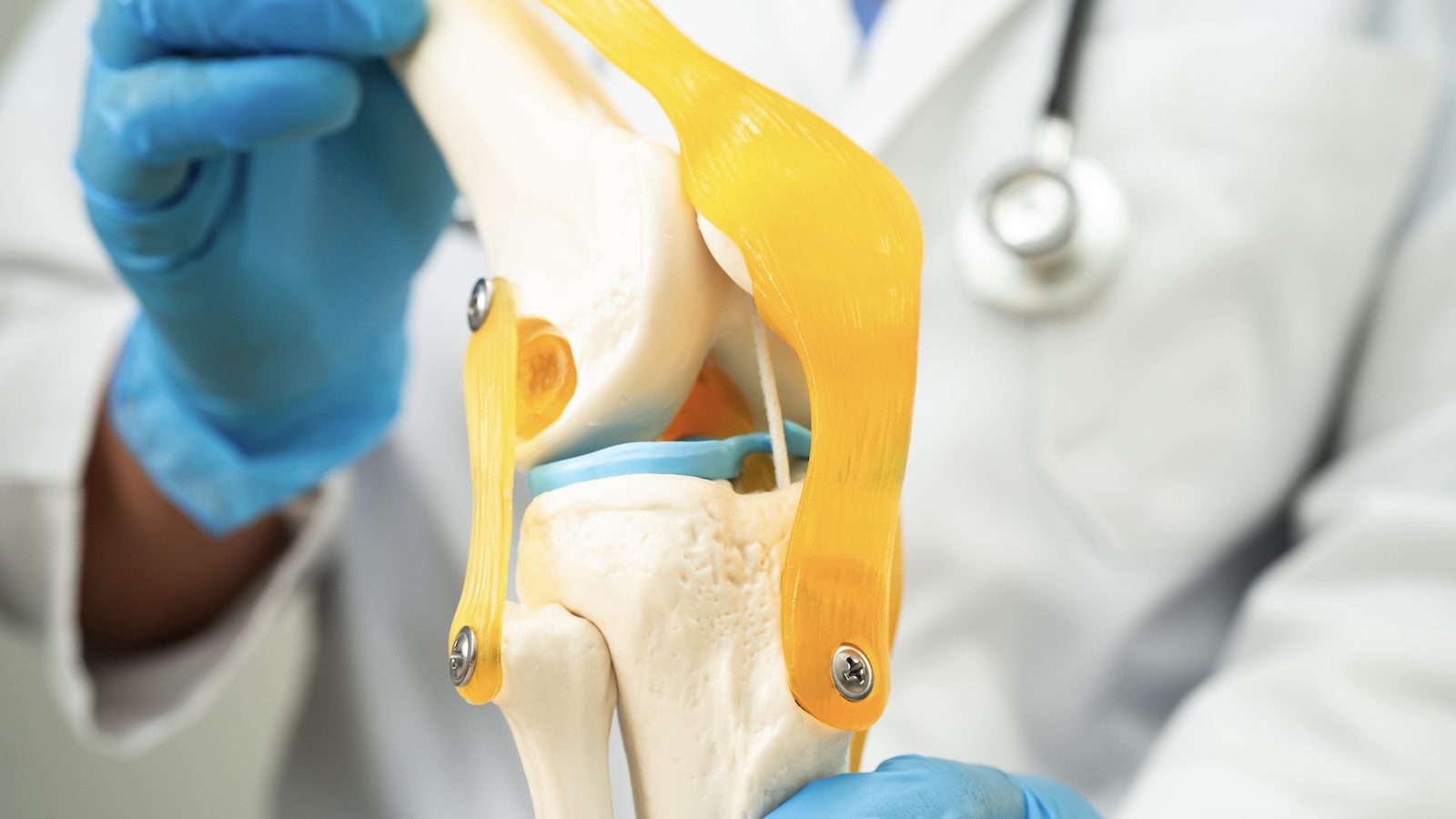

A knee replacement can do a lot for you.
It can help you walk farther, climb stairs, sleep more comfortably and get back to activities that you love. But before having surgery, many people have the same question: How long will the new knee actually last?
“For most patients, a knee replacement is a durable solution that can provide pain relief and improved function for many years,” says Donald Allen, MD, an orthopedic surgeon at the Hartford HealthCare Bone & Joint Institute. “And while no implant lasts forever, today’s knee replacements are going the distance.”
Here’s what you need to know.
1. Most knee replacements last longer than you think
Many people still think knee replacements only last about 10 years.
“Knee replacement technology has improved tremendously over time,” says Dr. Allen. “Today’s implants, materials and surgical techniques are designed to hold up through years of walking, bending, stairs and daily life.”
Studies show:
- About 82% of total knee replacements last at least 25 years
- About 90% of partial knee replacements last 15 years
“Many older adults may never need another knee surgery,” Dr. Allen adds. “And for a lot of patients, the benefit isn’t just less pain. It’s getting back mobility, independence and the freedom to move through the day without constantly thinking about their knee.”
> Related: Partial vs. Total Knee Replacement: Which Is Right for Me?
2. Partial knee replacement might be a better fit
Not every patient needs a full knee replacement.
“Patients are sometimes surprised to learn we don’t always have to replace the entire knee,” says Dr. Allen. “Sometimes only one part of the knee is damaged, and for the right person, a partial knee replacement can work extremely well.”
A partial knee replacement can:
- Feel more natural for some patients
- Preserve more of the natural knee
- Work well when arthritis is limited to one area
“A total knee replacement replaces the full joint and generally lasts longer overall,” Dr. Allen explains. “But that doesn’t automatically make it the better choice for every patient. It comes down to matching the surgery to the patient and choosing what will give someone the best long-term function.”
> Related: 6 Signs Your Knee Pain Is Actually Arthritis
3. Age changes the conversation a bit
A 50-year-old and a 75-year-old may both need knee replacement surgery.
“The age when someone has surgery absolutely affects how we think about implant longevity,” says Dr. Allen. “A younger patient may put more years, more steps and more activity on that implant over time, so we think carefully about how that knee may hold up decades from now.”
Younger patients are usually:
- More active
- More likely to outlive the replacement
- More likely to need revision surgery later
“We don’t want patients suffering unnecessarily,” Dr. Allen adds. “Waiting too long can have a downside too, especially if knee pain is limiting movement, strength or balance. The decision is about finding the right timing, not just the youngest or oldest age.”
> Related: Can’t Sleep Because of Knee Pain? Try These 7 Expert Tips
4. Knee replacements can wear down over time
Modern knee replacements are durable, but they aren’t magic.
“No implant lasts forever,” says Dr. Allen. “Even very successful knee replacements are still mechanical joints, which means wear can happen after many years of movement.”
There are common reasons a knee replacement may fail:
- Implant loosening
- Infection
- Instability
- Plastic component wear
- Fracture around the implant
“Many of these issues happen gradually,” Dr. Allen explains. “Patients may notice increasing pain, swelling, stiffness or instability years later, and those symptoms shouldn’t be ignored or brushed off as aging.”
Want a Weekly Dose of Health News?
5. Revision surgery is possible, but it can be more complicated
If a knee replacement wears out or develops a problem, surgeons can sometimes repair or replace part of the implant.
“That’s called revision surgery, and it’s often more complex than the original knee replacement,” says Dr. Allen. “There can be scar tissue, bone loss and more challenging reconstruction involved.”
Compared to the first surgery, revision surgery may involve:
- Longer recovery
- More technical challenges
- Less predictable outcomes
“We always want to optimize the initial surgery as much as possible,” Dr. Allen explains. “Revision procedures can help when problems happen, but they become progressively more difficult over time. That is why timing, implant choice, alignment and recovery planning all matter from the start.”
> Related: What NOT to Do After Knee Replacement Surgery
6. You play a role in your outcome
You can’t control every factor that affects how long your implant lasts.
“But there are definitely things you can do to help protect the replacement long term,” says Dr. Allen. “The choices you make after surgery, such as your activity level and follow-up care, can help your knee last as long as possible.”
Try this:
- Avoid repetitive high-impact activity
- Follow rehab recommendations
- Keep routine follow-up appointments
- Maintain a healthy weight
- Stay active with low-impact exercise
“We absolutely want patients moving after surgery,” Dr. Allen adds. “The goal is not to treat your new knee like it’s fragile. Instead, use it wisely with activities that support long-term joint health, such as walking, swimming, cycling and strength training.”
> Related: 6 Must-Do Exercises After Knee Replacement Surgery
7. Knee replacement technology keeps evolving
Joint replacement surgery today looks very different than it did 20 years ago.
“Knee replacement technology has advanced tremendously,” says Dr. Allen. “Today’s implants are designed to better mimic natural knee movement, improve durability, stability and overall function.”
But, even with newer technology, surgical technique and patient selection still matter enormously.
“The best implant still needs the right surgical plan, the right recovery and the right patient match,” says Dr. Allen.
> Related: Am I Too Old to Get My Knee or Hip Replaced? What to Consider at Age 70, 80 and Up
When should you talk to a doctor?
If knee pain is starting to affect your life, start the conversation.
“This doesn’t always mean you need surgery, but you should know what’s happening,” says Dr. Allen.
Whether it’s a nonsurgical plan today or time for surgery later, it comes down to your pain, mobility and quality of life.
“Patients don’t have to wait until they can barely walk, either,” says Dr. Allen. “If knee pain keeps you from moving through life the way you want to, getting answers sooner can help you make the right decision.”