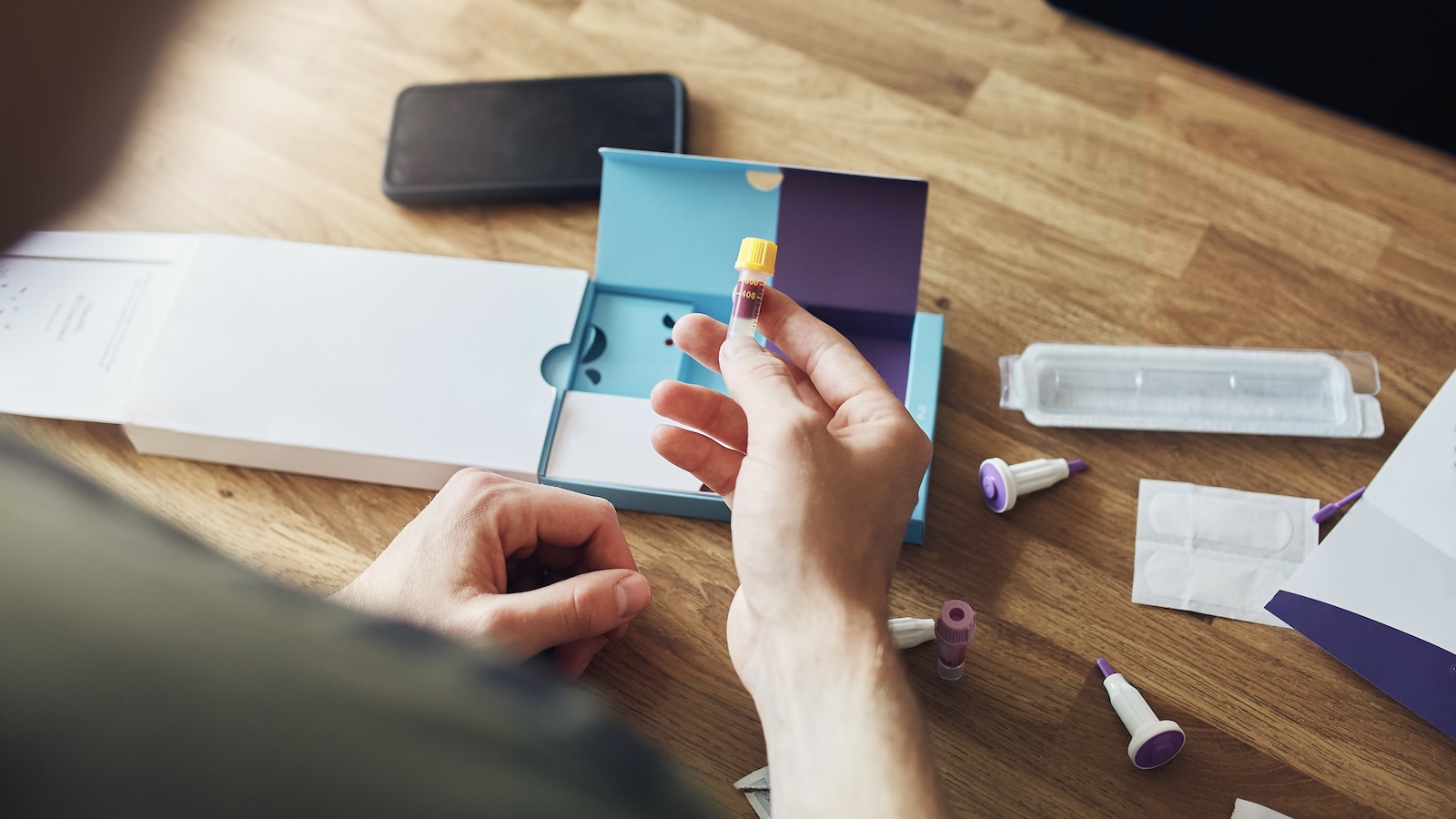

If you’ve been putting off your colonoscopy, a home stool test like Cologuard can sound pretty appealing.
No prep, no doctor’s office and no procedure.
But like most things that sound too good to be true, these home tests come with a catch.
“At-home colon cancer tests are not an even substitution for a colonoscopy. A colonoscopy doesn’t just detect colon cancer, it actually prevents it before it starts. If you’re eligible for one, it’s the best option you have,” says Amanda Ayers, MD, a colon and rectal surgeon with the Hartford HealthCare Digestive Health Institute.
Not convinced? Here’s what you need to know before replacing your colonoscopy with an at-home colon cancer test.
1. A colonoscopy can actually prevent cancer
This is the most important distinction between a colonoscopy and an at-home screening test.
Most stool-based tests look for signs that cancer may already be present, such as hidden blood or abnormal DNA. A colonoscopy, on the other hand, allows your doctor to remove precancerous polyps before they ever become cancer.
“Most colorectal cancers begin as polyps,” says Dr. Ayers. “During a colonoscopy, we can identify those growths and remove them immediately, often preventing cancer from developing in the first place.”
That is what sets a colonoscopy apart.
“It’s both a screening test and a preventive procedure,” Dr. Ayers adds. “No at-home test can remove a precancerous polyp.”
> Related: Colonoscopy vs. Cologuard: Which Is Right for You?
2. A negative at-home test doesn’t mean you’re in the clear
Sure, a normal result on your home test is reassuring.
But it’s important to understand what that result means. Stool-based tests are designed to detect specific warning signs, not every abnormality inside the colon.
“A negative result doesn’t guarantee that there aren’t polyps present,” says Dr. Ayers. “Some precancerous polyps don’t bleed or shed enough abnormal DNA to be detected by stool-based screening.”
That’s why timing is so important.
“A polyp that goes undetected today may continue growing over the next several years,” Dr. Ayers adds. “With a colonoscopy, we’re able to actually see those growths rather than relying on indirect signs.”
> Related: What to Expect Before Your First Colonoscopy
3. A positive test still means you’ll need a colonoscopy
You might not realize this until after you’ve mailed in your sample.
If an at-home screening test comes back abnormal, the next step is a diagnostic colonoscopy.
“A positive stool test doesn’t mean you have cancer,” says Dr. Ayers. “It just tells us that we need to look directly inside the colon to determine what’s causing the abnormal result.”
In other words, you might need a colonoscopy either way.
“You might think you’re avoiding a colonoscopy by choosing a home test,” Dr. Ayers adds. “But if that test is positive, you’ll still need the procedure.”
> Related: The 8 Best Foods for Your Colon
4. At-home tests aren’t right for everyone
These tests are intended for people at average risk for colorectal cancer.
But if you have a personal history of colon polyps, inflammatory bowel disease, certain inherited conditions or a family history of colorectal cancer, you may have to go straight to a colonoscopy.
“Screening recommendations aren’t one-size-fits-all,” says Dr. Ayers. “Your personal and family history play a major role in determining which test is most appropriate.”
Choosing the wrong screening test could delay important care.
“If you’re at higher risk, you’ll need the most thorough evaluation available,” Dr. Ayers adds. “Typically, that’s a colonoscopy.”
Want a Weekly Dose of Health News?
5. Colonoscopy is performed less often
Most at-home colon cancer tests need to be repeated every one to three years, depending on the type. But a colonoscopy usually doesn’t need to be repeated for 10 years.
“A normal colonoscopy provides a much longer screening interval because we’ve directly examined the entire colon,” says Dr. Ayers.
So while it might be an inconvenient day, it’s worth it for the peace of mind you’ll have for years to come.
“Many people are surprised to learn that if everything looks healthy, they may not need another screening colonoscopy for a decade,” Dr. Ayers adds.
> Related: You Had a Positive Cologuard Test. Now What?
6. The prep is better than it used to be
Let’s be honest: Most of us fear the prep more than the colonoscopy itself.
And while it still isn’t anyone’s favorite way to spend a day, colonoscopy prep today is much easier than you might expect.
“We hear horror stories from friends or family who had a difficult prep 20 years ago,” says Dr. Ayers. “The options have improved significantly, and we can work with you to find a prep option you can tolerate.”
For most people, it’s just a temporary inconvenience.
“Patients almost always tell us the anticipation was worse than the procedure itself,” Dr. Ayers adds.
> Related: 7 Common Questions About Colonoscopies
The goal isn’t to find cancer, it’s to prevent it
When found early, colon cancer is very treatable.
“Every screening test has value, but colonoscopy stands apart because it allows us to detect and remove precancerous polyps during the same procedure,” says Dr. Ayers. “That’s why it continues to be considered the gold standard.”
And perhaps the most important message?
“If an at-home colon cancer test is the only screening you’re willing to do, then it’s still worth doing it. But if you’re choosing between screening options, understand that a colonoscopy offers the greatest opportunity to protect your long-term health, and it truly has the potential to save your life.”